



The average dental practice loses more than €150,000 annually from lapsed patients. Forty percent of new patients never return for recall visits, and front-desk teams spend hours each week chasing appointments that could book themselves. We're seeing practices reclaim 15 or more hours monthly by automating recall outreach, freeing staff to handle the calls that actually need a human touch.
The hidden cost of manual recall: front-desk capacity, not just revenue
The revenue loss from lapsed patients grabs attention. €150,000 annually, 40% of new patients disappearing after their first visit. But the operational drain often hits harder.
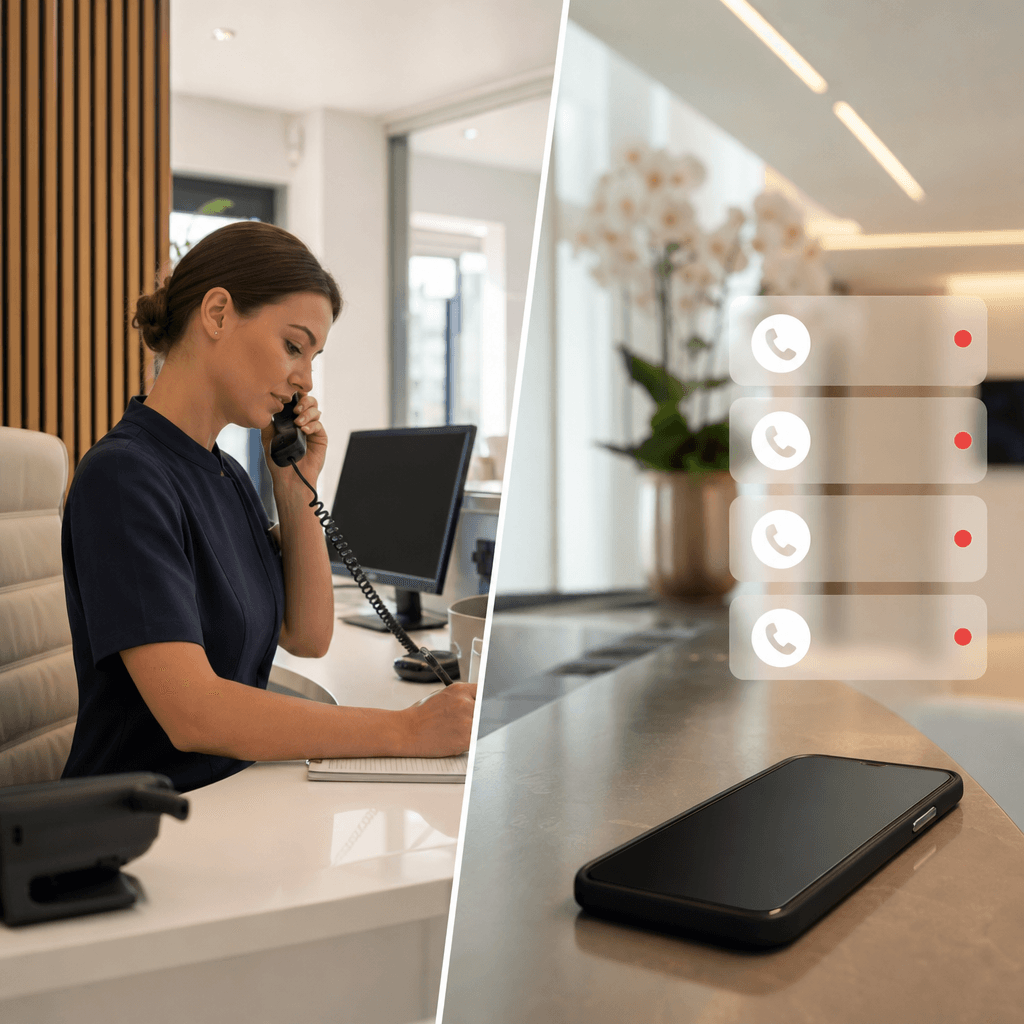
Step 1: Front-desk time disappears into routine calls. Staff spend 3 to 4 hours daily on scheduling calls. That's half the workday gone before anyone handles a complex patient question or coordinates treatment plans.
Step 2: The recall workflow compounds the problem. Tracking spreadsheets. Dialing outdated numbers. Leaving voicemails that rarely get returned. Following up on the same patients three, four, five times. Each step multiplies the time investment with diminishing returns.
Step 3: Incoming calls suffer. While staff chase lapsed patients, current patients with urgent needs or scheduling questions hit voicemail. The practice loses capacity to serve the people already committed to their care.
Step 4: The real reframe becomes clear. Recall is not a marketing task. It's a continuity-of-care function competing directly with front-desk core duties. And right now, it's winning that competition in the worst possible way.
We're seeing practices lose 13 to 81 hours monthly to manual recall outreach, depending on size. Those hours represent real capacity: patients who couldn't get through, questions that went unanswered, urgent cases that waited longer than they should have.
Why manual outreach fails: the mismatch between effort and results
Manual recall achieves 15 to 20% booking rates. Automated systems reach 30 to 45%, with some campaigns exceeding 50%. The gap is staggering given the hours poured into phone-based outreach.
The core problem is channel mismatch. Staff default to phone calls because managing multiple channels manually is impractical. Yet 78 to 80% of patients prefer text and email reminders over calls. SMS outperforms email by 3x in response rates. The math is brutal: practices invest their most labour-intensive method into the channel patients want least.
The European context makes this worse. In the Netherlands and Belgium, WhatsApp dominates personal communication. Manual recall processes miss patients entirely on their most-used platform. A receptionist cannot efficiently juggle phone calls, text messages, emails, and WhatsApp conversations while also greeting patients at the front desk. So practices stick with phone calls and watch response rates flatline.
We're seeing a clear pattern across practices. Receptionists work harder for worse outcomes. They dial numbers that go to voicemail. They leave messages that never get returned. They spend their afternoons on outreach that yields one booking for every five or six calls. Meanwhile, their primary responsibility suffers. Live patients wait. Urgent calls ring out. The front desk becomes a call centre instead of a care coordination hub.
Recall automation as front-desk infrastructure: reclaiming 13-81 hours monthly
For the demand side of the same bottleneck, see how chair utilization starts with call handling when unanswered calls turn into empty agenda space.
The math is straightforward. Automation handles initial outreach, follow-up sequences, and confirmation collection. Staff handle the calls that need judgment, empathy, or clinical coordination. The split creates breathing room that manual processes simply cannot.
Mid-sized practices typically recover 15 to 20 hours monthly. Those hours translate directly to capacity: 40 to 60 additional inbound calls handled without hiring anyone new. A receptionist who spent her afternoon dialing lapsed patients now answers the phone when a current patient calls with an urgent question.
The multi-channel advantage matters enormously here. Automated systems work across SMS, email, and WhatsApp simultaneously, with GDPR-compliant consent management built into every touchpoint. No receptionist can efficiently manage that spread while greeting patients and coordinating schedules. Voicelabs Dental handles the repetitive volume while staff focus on conversations that actually require a human presence.
We're seeing practices reframe automation entirely. Not as a replacement for staff, but as infrastructure that converts outbound chasing into patient-facing availability. The receptionist's role shifts from call centre agent back to care coordinator. Complex cases get attention. Urgent requests get answered. The front desk functions as a front desk again.
The recovered hours compound over time. A practice saving 15 hours monthly gains 180 hours annually, nearly five full working weeks of capacity returned to patient care.

"Same team, same hours, twice the patient availability."
From lapsed patient recovery to continuity-of-care automation
The traditional framing treats recall as a revenue recovery exercise. Chase lapsed patients, book appointments, capture lost income. But the real function runs deeper: recall protects the continuity of care.
Patients who drift away rarely make a conscious decision to leave. Life gets busy. Reminders slip through. Six months becomes a year, then two. Systematic outreach keeps those relationships alive before they end silently. Practices using AI-driven recall recover 15 to 25% of lapsed patients, maintaining connections that would otherwise dissolve without a word.
"Every patient who re-engages is a relationship preserved, not just revenue recovered."
The benefits extend beyond reactivation. Patients who receive consistent automated touchpoints become more reliable overall. A 67% reduction in no-shows is the clearest indicator. At €120 to €200 per missed appointment, that translates to €10,000 or more in monthly savings and significantly better chair utilization.
The European healthcare context adds another dimension. Patient communication must balance proactive outreach with privacy expectations. Ad-hoc manual processes create compliance risks. One receptionist texting patients from a personal phone, another sending emails without proper consent tracking. Automated GDPR-compliant systems standardize every touchpoint, making systematic outreach both legally sound and operationally sustainable.
We're seeing practices shift their entire perspective. Recall becomes infrastructure for patient relationships, not just a revenue recovery tactic. The difference shows in retention rates, show rates, and the quality of ongoing care.
Measurable outcomes: what recall automation delivers for practice operations
The numbers from one mid-sized practice tell the story clearly. Over 90 days, they reactivated 280 lapsed patients with an average treatment value of €640 per patient. Total recovered revenue: €179,200. The striking part? Front-desk staff spent that quarter handling current patients rather than running outbound campaigns.
That's the capacity connection in action. Recovery happened because automation handled the outreach volume while receptionists stayed available for incoming calls.
The downstream effects multiply. Practices with strong recall see a 30% reduction in new patient acquisition costs. Retained patients cost nothing to acquire twice. Marketing budgets stretch further when fewer patients drift away in the first place.
Chair utilization improves from two directions simultaneously. Fewer empty slots from no-shows. More appointments from recovered patients. Clinical time becomes more productive without adding hours or staff. Practices looking to streamline their front office operations often find recall automation delivers the fastest measurable returns.
The compound effect matters most. Better reachability leads to better retention. Better retention leads to fuller schedules. Fuller schedules lead to more efficient use of clinical resources. All from shifting how front-desk hours get spent.
We're seeing practices track these gains month over month. The €179,200 recovery stands out, but the operational improvements, fewer missed calls, better show rates, more productive chairs, compound long after the initial reactivation campaign ends.
Implementing recall automation: practical considerations for European practices
If your automation budget is already moving, use the billing-versus-reception automation diagnostic to decide whether recall, scheduling, or billing should come first. An AI dental receptionist turns those freed hours into booked recalls, because the follow-up call gets answered too.
The practices seeing the strongest results share a common starting point: understanding where front-desk hours actually go. A simple week-long audit reveals the split between recall outreach and live patient calls. That baseline makes capacity gains measurable from day one.
Channel selection varies by market. SMS works across all European patient bases, but practices in the Netherlands and Belgium find WhatsApp integration essential. Patients there rarely respond to channels they don't already use daily. The automation platform needs to meet patients where they communicate, not force them into unfamiliar formats.
"The best recall system is the one patients actually respond to, on the channel they already check."
GDPR compliance is non-negotiable. Automated workflows need consent management built into every sequence, with clear opt-out mechanisms that update patient preferences instantly. Manual processes create gaps. A receptionist sending ad-hoc messages from various platforms leaves compliance to memory and good intentions. Structured automation eliminates that risk.
Calendar integration determines whether automation saves time or adds steps. The goal is direct booking into existing scheduling systems. If staff still need to manually transfer appointments from a separate platform, the efficiency gains disappear.
Success metrics should track both sides of the equation: recall rates and revenue recovered, but also calls answered, average response time, and front-desk availability. The capacity shift matters as much as the reactivation numbers.
See how Voicelabs Dental automates recall while keeping your front desk available for the patients who need you now. Request a demo to calculate your practice's capacity gain.