




Over 70% of dental appointments are still booked by phone, yet a quarter to more than a third of those calls come in when no one is there to answer. The math gets uncomfortable quickly: 60 to 70% of after-hours callers want to schedule an appointment, not report an emergency. Only 15 to 25% bother leaving a voicemail. The rest? They call the practice down the street.
The 8 hours nobody's answering: Where your patients really call
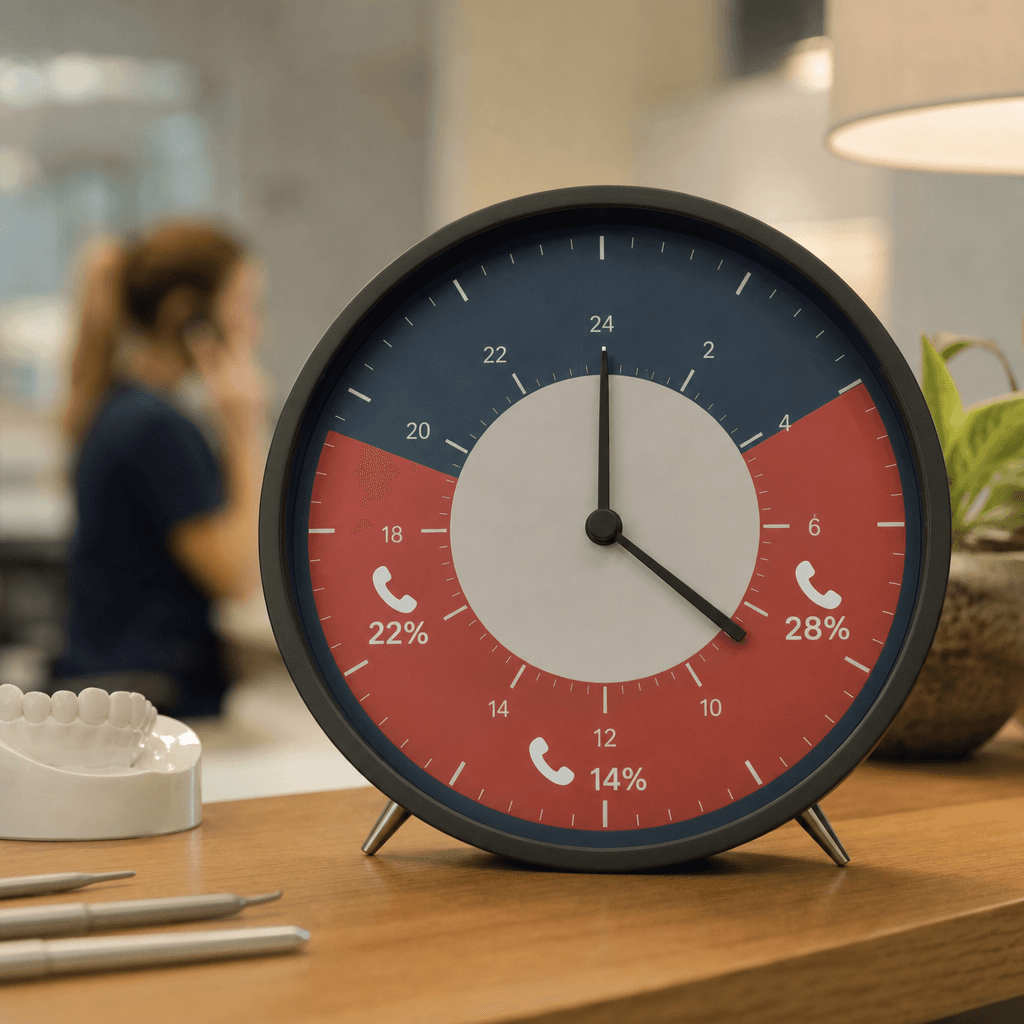
Most practices pour energy into optimizing the 9-to-5 rush. Understandable. That's when the waiting room fills and the phones light up. But the data tells a different story: 25 to 38% of all calls arrive when no one's at the desk to pick up.
Step 1: The after-work surge. Around 7pm, patients finally have a moment to address the toothache that's been building all day. They call. No answer.
Step 2: Saturday morning. Errand time. Patients knock out their to-do list, dental appointment included. This window alone accounts for 10 to 15% of weekly call volume. The practice is closed.
Step 3: Weekday lunch breaks. For working patients, noon is often the only free moment. Many practices run a skeleton crew or close the front desk entirely during lunch.
Here's what makes these missed calls so expensive: we're not talking about spam or robocalls. 60 to 70% of after-hours callers want to book an appointment. They're ready to schedule, credit card in hand. This is ghost revenue, real demand that evaporates before anyone knows it existed.
The uncomfortable truth? 65% of unanswered callers won't try again. They move on to whichever practice picks up first.
The Saturday morning caller: A patient journey your practice never sees
It's 9:47am on a Saturday. A parent is loading groceries into the car when their eight-year-old mentions that tooth has been hurting again. Football practice starts in an hour. The parent pulls out their phone, searches for the practice number, and calls.
Voicemail.
Here's where the story typically ends. The parent makes a mental note to call Monday, then forgets. Or they scroll down to the next search result and try another practice. One that picks up.
The numbers behind this scenario are sobering. If a practice receives 30 after-hours calls weekly, and 70% of those callers want to book an appointment, that's 21 potential patients. Now apply the voicemail problem: 75% of callers hang up rather than leave a message. That's roughly 16 patients per week who wanted to schedule but never got the chance. Over a year, the losses add up fast.
Modern phone systems change this dynamic entirely. Intelligent routing can redirect calls to available staff or an answering service during peak off-hours. Voicemail-to-text features mean Monday morning triage happens in minutes rather than hours. AI-assisted scheduling tools can capture the booking request instantly, sending the caller a confirmation text before they've even reached the football pitch.
The Saturday morning parent gets acknowledgment. The practice gets the appointment. Nobody calls the competition.

VoIP features that actually matter for after-hours capture
The features that recover Saturday's lost revenue aren't the flashy ones. They're the ones that turn missed calls into Monday morning action items.
Voicemail-to-text sits at the top of the list. Only 15 to 25% of after-hours callers leave a message, but those who do represent the most motivated patients. When voicemails arrive as readable text, staff can triage urgent cases from routine requests before their first coffee. A parent describing a child's swelling gets prioritized. A new patient asking about whitening options goes into the callback queue. The sorting happens in minutes, not the 45-minute voicemail marathon many practices dread.
Smart call routing adds another layer. When a weekend caller is an existing patient, modern systems can surface their record, last appointment date, and treatment history the moment staff responds. The callback becomes a conversation, not an interrogation.
Then there's practice management integration. Choosing the right phone system for your dental practice means knowing exactly who called and why before you dial back. That Saturday missed call? Turns out the patient is eight months overdue for hygiene, the category with 18 to 25% no-show rates. Staff can address the lapse proactively, turning a simple callback into a retention opportunity.
The framing matters here. These aren't IT upgrades. They're revenue recovery tools. Every feature exists to capture appointments that would otherwise become competitor bookings.
Calculating your practice's after-hours revenue gap
The math behind missed calls is straightforward, and that's what makes it uncomfortable.
A simple framework gets to the number fast: weekly call volume, multiplied by your after-hours percentage, multiplied by scheduling intent, multiplied by voicemail abandonment rate, multiplied by average patient lifetime value. The result is annual opportunity cost sitting on the table.
Here's how it works with real figures. A practice receiving 200 calls per week sees roughly 60 of those arrive after hours. Of those 60 callers, about 39 want to book an appointment. Apply the voicemail problem: 75% hang up without leaving a message. That's 29 patients per week who wanted to schedule but never got through. At an average patient value of €700, the annual opportunity cost reaches €20,300.
Traditional solutions carry their own price tag. Part-time receptionist coverage for Saturdays runs €15,000 to €20,000 annually when you prorate a fully loaded salary. VoIP with smart routing and voicemail-to-text costs a fraction of that, often paying for itself within weeks rather than months.
The comparison becomes even clearer at smaller scales. Even capturing 10 additional patients monthly from after-hours calls, patients who would have called the next practice on the list, covers most phone system investments several times over. The patients were already calling. The only question is whether someone, or something, picks up.
From missed call to Monday appointment: Building the recovery workflow
The practices recovering Saturday's lost revenue share a common thread: a clear after-hours call flow that turns missed connections into Monday bookings.
Step 1: The professional greeting. Callers hear options immediately. Emergency pain cases route to an on-call line or after-hours service. Scheduling requests flow to voicemail-to-text capture. The distinction matters: urgent cases get handled, routine requests get logged.
Step 2: Instant acknowledgment. The moment a caller leaves a message, an automatic text confirms receipt. "We've got your request and will call Monday morning." That single touchpoint stops the scroll to competitors. The patient knows they're in the queue.
Step 3: Monday morning triage. Voicemails arrive as readable transcripts, sorted by timestamp. Modern AI-assisted systems can flag urgent pain descriptions versus routine hygiene requests, letting staff prioritize callbacks appropriately. A parent describing swelling gets the first call. A whitening inquiry can wait until 10am.
Step 4: Multi-channel follow-up. Captured contact info pairs with the same reminder systems that reduce no-shows by 30 to 45%. Text confirmations go out immediately after booking. WhatsApp follow-ups handle last-minute questions.
The real bottleneck sits at response speed. With 70% of appointments still booked by phone, the practice that calls back Saturday's missed callers first wins Monday's schedule. Voicelabs Dental helps practices close that gap, turning weekend voicemails into confirmed appointments before competitors even check their messages.
What to evaluate before upgrading your practice phone system
The difference between a phone system that works and one that collects dust comes down to a handful of practical questions. This is the gap an AI dental receptionist closes: every after-hours call is answered and booked instead of sent to voicemail.
-
Practice management integration. The systems worth considering show patient records, appointment history, and outstanding balances before staff pick up the phone. Without this integration, callbacks become fishing expeditions. With it, every conversation starts informed.
-
Language accuracy for voicemail-to-text. Transcription quality varies wildly across providers. Dutch, Flemish, and English each present different challenges. A system that garbles "wortelkanaalbehandeling" into nonsense creates more work than it saves. Testing with actual patient voicemails, before signing anything, reveals the truth quickly.
-
GDPR compliance for stored recordings and transcriptions. Patient health information lives in those voicemails. European practices need clear data retention policies, secure storage, and documented consent processes. The cheapest option often becomes the most expensive when regulators come asking.
-
Staff adoption reality. Complex routing trees with six layers of options look impressive in demos. In practice, confused staff bypass them entirely. The practices seeing results keep their call flows simple: two or three clear paths, intuitive for both callers and the team answering.
-
Metrics that matter. After-hours call volume, voicemail completion rates, and time-to-callback tell the real story. Tracking these numbers before and after implementation shows whether the investment is working.
Want to see how many after-hours calls your practice is missing? Voicelabs Dental can analyze your current phone patterns and show you exactly where patients are slipping through. Request a practice reachability assessment.