




Patients who receive no reminders miss 25 to 35 percent of their appointments. Add multi-channel messaging and that number drops to 8 to 12 percent. The math is clear. But here's where it gets tricky: the same patient might receive a recall text, a confirmation email, a WhatsApp follow-up, and a phone call, all within the same week. We're seeing practices lose the goodwill they've built when well-intentioned reminder systems start to feel like spam. The difference between reducing no-shows and annoying patients often comes down to timing and coordination.
The hidden cost of stacking reminder systems
Multi-channel reminders reduce no-shows by 30 to 45 percent. That's well documented. Yet practices running recall, confirmation, and follow-up systems independently often triple-message patients in critical windows. The paradox is real.
Here's what the typical collision looks like. A hygiene recall reminder lands on Monday. A confirmation SMS follows on Tuesday. Then a pre-visit form request arrives Wednesday. All for the same Thursday appointment. Three separate systems, zero coordination, one increasingly irritated patient.
Hygiene appointments sit at the center of this problem. With no-show rates between 18 and 25 percent, they demand the most proactive outreach. They also carry the highest fatigue risk. We're seeing practices caught in a loop: the more they try to reduce missed hygiene visits, the more messages they stack into a 48-hour window.
The core tension is clear. The same communication discipline that achieves 86 to 92 percent patient retention can erode trust when systems operate without awareness of each other. Recall builds the relationship. Confirmation protects the schedule. But when both fire simultaneously, patients stop reading. They start blocking.
The rule of three, email at one week, SMS at two to three days, same-day reminder, works well for confirmation. Layer it over an active recall campaign, and the math breaks down fast.
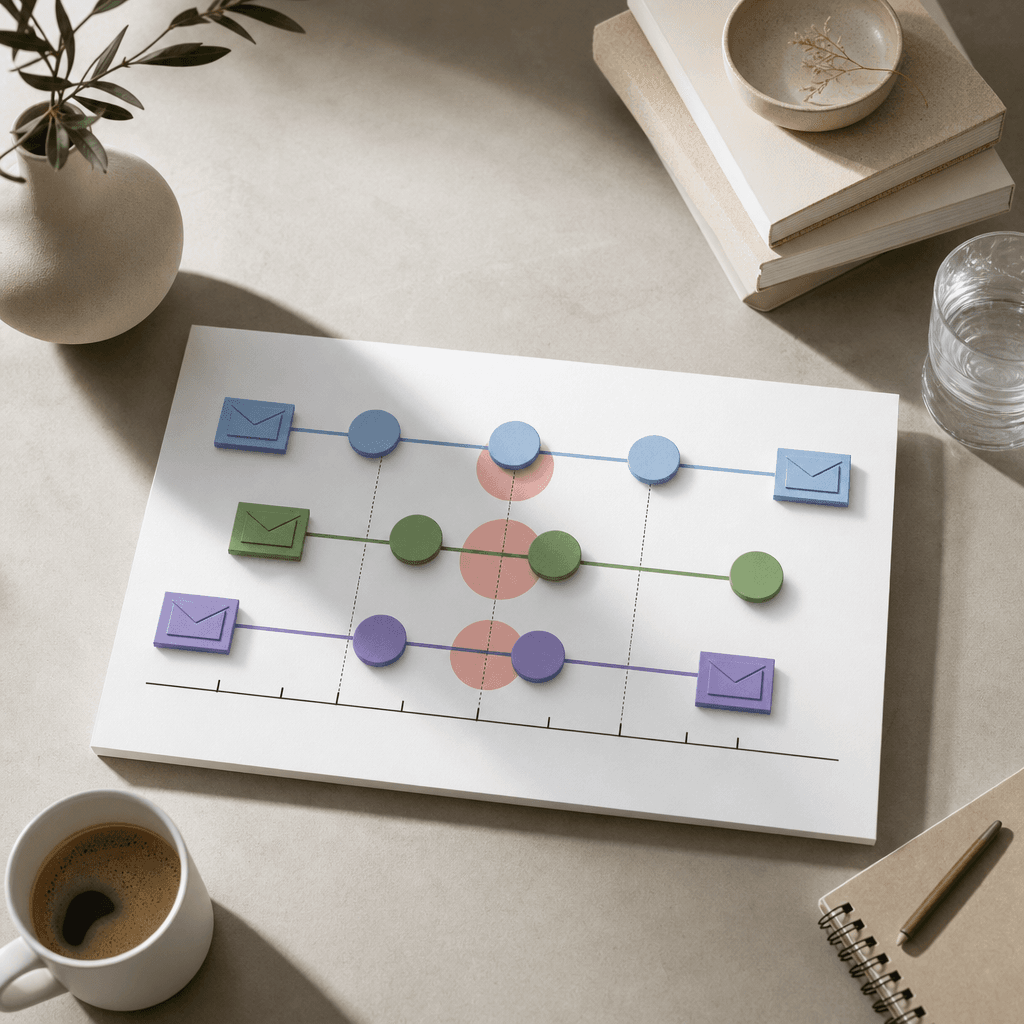
"Three systems trying to help often create one very annoyed patient."
Mapping your practice's complete messaging timeline
Five touchpoints define the patient communication arc. Recall outreach starts the sequence. Confirmation request protects the booking. Pre-visit intake collects forms and medical updates. Day-of reminder reduces last-minute drops. Follow-up or feedback request closes the loop. Each serves a purpose. Together, without coordination, they create noise.
The overlap problem becomes visible when practices map every automated message a single patient receives. One hygiene patient might get contacted by the PMS, the recall tool, a separate reminder platform, and WhatsApp follow-up. Four systems, no shared calendar, no awareness of what the others sent.
Here's where the data gets interesting. Reminders sent three weeks ahead achieve 79% confirmation rates, matching the 3-5 day window that most practices target. That suggests early recall outreach can absorb some confirmation function. Practices using this approach reduce the message density in that final 48-hour window where fatigue peaks.
The rule of three, email at one week, SMS at two to three days, same-day reminder, works well in isolation. Layer it onto an active recall campaign and the math compounds. A patient who received recall messages at 4 weeks and 3 weeks now gets confirmation messages at 7 days, 3 days, and same-day. Six touches for one appointment.
Smart practices are running a simple exercise: tracking every automated message one patient receives across all systems for a single appointment cycle. The results often surprise even experienced teams.
The message collision audit: Counting touches in a 2-week window
The most effective practices we're seeing run a simple exercise. They select 10 patients with appointments in the coming fortnight and manually track every outbound message those patients receive. Every email, SMS, WhatsApp message, and phone call across every system.
The categorization matters. Each touch gets logged by purpose: recall, confirmation, intake, reminder, or follow-up. Then by channel. Then by source system. Patterns emerge quickly. Most practices discover their worst collisions happen in the 48 to 72 hours before hygiene appointments, exactly when patient tolerance runs lowest.
A reasonable benchmark is emerging from practices that have run this audit. No more than four purposeful touches in the two weeks before an appointment, with at least 48 hours of breathing room between messages. Anything beyond that tips into fatigue territory.
For European practices, there's an additional dimension. GDPR consent fatigue compounds messaging fatigue. Every unnecessary touch increases opt-out risk. A patient who withdraws communication consent doesn't just block one reminder. They disappear from recall, confirmation, and follow-up sequences entirely. The operational cost of one annoyed patient extends far beyond a single missed appointment.
The audit takes about 30 minutes. The findings often reshape how teams think about their entire communication stack.

Building suppression rules between recall and confirmation systems
Suppression logic prevents the collision problem at its source. The principle is straightforward: if a patient confirmed via recall outreach within the past seven days, the standard confirmation sequence becomes redundant. Smart practices skip it entirely and move directly to a single day-of reminder.
The timing sensitivity matters here. AI-powered confirmation calls achieve 70 to 85 percent confirmation rates compared to 40 to 60 percent for manual staff calls. But those numbers hold only when the call carries genuine urgency. Patients who've already received three recall messages in the preceding week often dismiss the confirmation call as noise. The urgency signal gets lost.
A practical decision tree is emerging from practices running coordinated systems. If a patient responded to any message in the past 72 hours, the next scheduled automated touch gets suppressed. The system flags for human review only if no confirmation arrives by 24 hours before the appointment. This preserves staff time for cases that genuinely need attention.
The rescheduling opportunity makes coordination even more critical. Between 40 and 60 percent of would-be no-shows will reschedule when offered an easy alternative during confirmation. But this only works when the practice hasn't exhausted goodwill through prior over-messaging. A patient who feels spammed won't engage with a rescheduling offer. They simply stop responding.
Voicelabs Dental builds this suppression logic directly into the confirmation workflow, checking recent patient activity before any outbound touch fires. The result is fewer messages with higher response rates.
When to skip a touch: Decision trees by appointment type and patient history
Not all appointments need the same outreach intensity. Emergency appointments carry 5 to 10 percent no-show rates because patient motivation is already high. A single day-of confirmation suffices. Anything more feels excessive to someone who called in pain 48 hours ago.
Hygiene appointments present a different picture. The higher no-show rates demand structured recall, but smart practices are consolidating confirmation into the recall response flow rather than layering a separate sequence on top. When a patient confirms through the recall message, the system recognises that response and skips redundant follow-up.
A practical pattern is emerging around recent interactions. If a patient called, messaged, or visited within the past 14 days, practices are cutting automated touches by half. The logic is simple: someone who just spoke with the team doesn't need another reminder that they have an appointment. A single confirmation closes the loop. Practices using dental recall systems with built-in suppression logic report stronger patient engagement precisely because they message less, not more.
The front-desk impact is significant. Full-time reception staff spend one to two hours daily on manual confirmation calls for just two providers. Smart suppression rules eliminate redundant outreach before it reaches the call list. Staff time shifts from dialing patients who already confirmed to handling the cases that genuinely need attention. The workload drops on exactly the days it would otherwise peak.
Orchestrating high-trust outreach without manual overhead
The goal is straightforward: achieve no-show rates of 8 to 12 percent while sending fewer, better-timed messages that respect patient attention. An AI dental receptionist makes the reminder two-way: the patient can call back and confirm or move the appointment at any hour.
-
Structured recall drives 86 to 92 percent retention at top practices, but only when confirmation messaging is orchestrated rather than layered. The practices seeing the best results treat recall and confirmation as a single coordinated flow, not separate systems competing for the same patient's attention.
-
For European practices, intelligent message orchestration solves a dual problem. GDPR consent management becomes simpler when patients receive fewer, more purposeful touches. Every suppressed redundant message reduces opt-out risk and preserves the communication channel for moments that matter.
-
The operational win compounds over time. Fewer outbound messages means less manual follow-up when systems misfire. Reception teams shift from chasing confirmations to focusing on in-person patient care, exactly where their attention adds the most value.
-
Patient relationships improve when practices communicate with intention. A single well-timed confirmation carries more weight than three automated touches in 48 hours. Trust built through structured recall stays intact when the confirmation layer respects what came before.
The math favours coordination. Better outcomes, less effort, stronger patient relationships.
Want to see how Voicelabs Dental orchestrates recall, confirmations, and follow-ups into a single intelligent patient communication flow? Book a demo to audit your current messaging timeline.