

EU dental practices face a compliance puzzle that many answering services overlook. Patient records require a minimum 10 years of retention, radiographs need full audit trails from exposure to deletion, and every digital scan or photograph falls under both GDPR and Medical Device Regulation 2017/745 simultaneously. For any dental answering service handling patient data, these overlapping rules create real operational challenges. We're seeing practices rethink how their call handling partners store, access, and protect sensitive information.
Why patient calls trigger complex EU data obligations
A recall reminder call seems straightforward enough. The receptionist checks the system, confirms the date, and the patient hangs up. But the moment that conversation touches on treatment history, mentions a radiograph from last year, or involves scheduling for a child, two regulatory frameworks activate at once.
For EU dental practices handling patient-identifiable data, both GDPR and EU Medical Device Regulation 2017/745 apply simultaneously. Digital scans, photographs, and impressions all fall under this dual oversight. The call itself becomes a data processing event with real compliance weight.
We're seeing practices assume their liability ends when calls go to an external partner. It doesn't. Whether calls are handled in-house, outsourced to a traditional answering service, or managed by an AI receptionist, the practice remains the data controller. The legal responsibility stays with the practice owner, regardless of who picks up the phone.
This creates a practical problem for anyone evaluating call handling solutions. The question isn't just whether a service can book appointments efficiently. Practice owners need to verify how patient data flows, where it's stored, who can access it, and whether audit trails meet both GDPR and MDR requirements.
The sections ahead break down these obligations into an operational checklist, covering what to ask any call handling partner before signing a contract.

Retention timelines your answering service must support
The retention clock starts ticking the moment patient information enters any system, including your call handling solution. EU member states generally require dental records retention for a minimum of 10 years from the date of last treatment for adult patients, and until at least the patient's 25th birthday for records created during childhood.
-
Call logs, voicemails, and conversation summaries containing clinical information become part of the patient record. A voicemail mentioning pain after a recent extraction or a call summary noting a child's orthodontic progress falls under the same retention rules as the treatment notes themselves.
-
Many traditional answering services and basic voicemail systems automatically delete recordings after 30 to 90 days. For practices assuming those records are safely stored, this creates an invisible compliance gap.
-
The retention period varies by country, but the principle holds across the EU. A call from 2024 about a seven-year-old patient may need to remain accessible until 2042 or later.
-
Storage alone isn't enough. Records must remain accessible and auditable throughout the full retention period, with clear documentation of who accessed what and when.
The vendor selection question becomes straightforward: can your call handling solution store data securely for the full retention period required in your jurisdiction? Practices evaluating any service, whether a traditional answering provider or an AI receptionist, need a clear answer before signing.
Radiograph discussions and the documentation trail
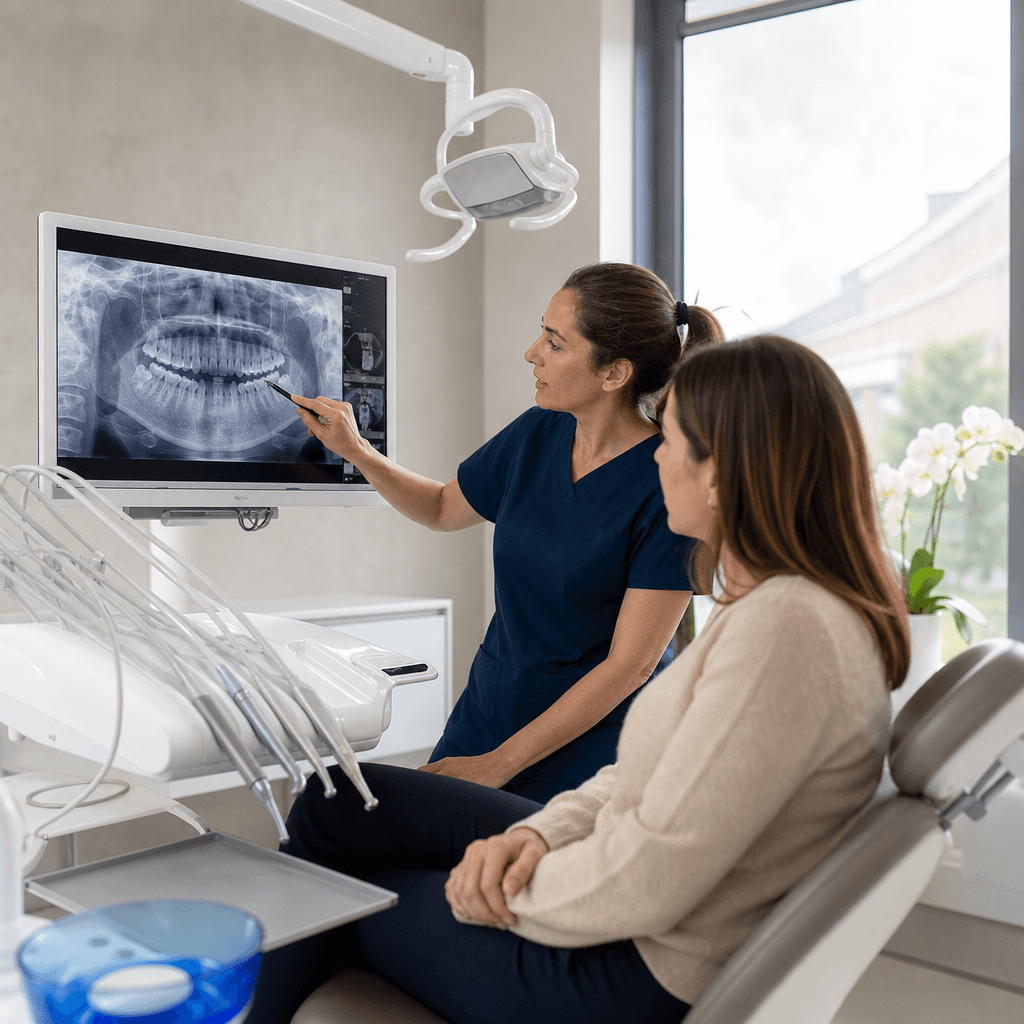
Radiograph documentation in EU dental practices involves more than storing an image. Every radiograph requires written clinical justification recorded before exposure, an image quality assessment, a diagnostic report, and audit trails for image access throughout the full retention period. The chain of documentation starts before the X-ray button is pressed and extends for years afterward.
Consider a common scenario. A patient calls asking about an X-ray taken last year, wanting to know the findings or requesting the image for a specialist referral. The receptionist pulls up the record, discusses the date and clinical context, and confirms the next steps. That conversation, if recorded by an answering service, becomes part of the radiograph documentation chain.
The same applies when reception schedules a radiographic examination and notes the clinical reason. A call summary stating "patient reports persistent pain in lower left quadrant, bitewing scheduled to assess potential decay" now carries audit trail requirements identical to the radiograph itself.
This creates a practical compliance checkpoint for any call handling solution. The question isn't whether calls are recorded. The question is whether the system logs who accessed those recordings, when access occurred, and whether this audit trail can be produced for regulatory inspection. Practices working with traditional answering services or AI receptionists need clarity on this before any data flows through the system.
Scheduling recall and no-show follow-up within GDPR limits
No-shows and last-minute cancellations remain the top scheduling headache for dental practices. According to the ADA Health Policy Institute, 82% of dentists identify this as the primary reason their chairs don't reach full capacity. The financial impact compounds over time, with successful practices aiming to keep annual patient attrition below 15% through strong recall systems supporting regular hygiene visits.
Effective recall outreach depends on storing patient contact details, preferred treatment intervals, and communication preferences. All of this qualifies as personal data under GDPR. The practice needs lawful basis for processing, clear consent records, and functional opt-out mechanisms for every communication channel.
This is where many call handling solutions fall short. A patient might prefer WhatsApp reminders over phone calls, or SMS confirmations over email. The answering service handling these touchpoints needs to track not just the message content but the consent status behind it. When a patient texts "STOP" to a recall reminder, that preference must update across all systems immediately.
We're seeing practices treat recall workflows as a compliance checkpoint rather than just a scheduling convenience. The question worth asking any potential partner: can the system send recall reminders via WhatsApp or SMS while maintaining verifiable consent records and processing opt-outs in real time? Practices exploring multi-channel patient communication can review how WhatsApp and web chat for dentists fits into compliant recall workflows.
Custom devices and MDR documentation at intake
Custom-made dental devices trigger specific EU MDR documentation requirements that extend into call handling workflows. Prosthetic appliances, orthodontic devices, and occlusal splints all require mandatory written statements, device labels, and instructions for use under the regulation.
-
A patient calling about an impression appointment or to report an issue with their crown is referencing an MDR-regulated device. The conversation content matters for compliance, not just scheduling.
-
Traditional answering services often treat these calls identically to routine hygiene bookings. The distinction carries regulatory weight that generic call handling misses entirely.
-
If your call handling solution manages intake for device-related appointments, it must support documentation handoff to your clinical records system. The written statement requirement means clinical context from the initial call may need to link directly to the device file.
-
Practices using an AI dental receptionist can configure the system to flag device-related calls for proper clinical follow-up. A patient mentioning discomfort with their night guard or questions about a new partial denture gets routed differently than a standard cleaning request.
-
Outsourced solutions without this flagging capability create manual sorting work for front-desk teams, or worse, gaps where device issues slip through as routine scheduling.
The evaluation question for any call handling partner: can the system distinguish MDR-relevant conversations and route them appropriately, or does every call receive identical treatment regardless of clinical documentation requirements?
Your vendor selection checklist for compliant call handling
Digital systems handling patient data must store information in formats that remain accessible throughout the full retention period. This technical requirement sounds simple enough. The practical reality is that many call handling solutions lack the architecture to support decade-long data accessibility, format migration, and audit readiness.
Practice owners evaluating any answering service, whether human-operated, AI-powered, or hybrid, benefit from asking direct questions before signing contracts:
- Does the provider store data within EU jurisdiction, with documented data residency guarantees?
- Can retention periods be configured to match your member state's requirements, including extended timelines for minor patient records?
- Are audit trails available on demand, showing who accessed recordings and when?
- How does patient data hand off to your practice management software, and is that transfer encrypted and logged?
- Does the system track consent status for recall outreach across SMS, WhatsApp, and phone channels?
- Can the solution distinguish MDR-relevant calls from routine scheduling?
The cheapest option often looks attractive until an inspection reveals gaps in documentation or missing records from a patient seen eight years ago. Hidden compliance costs emerge precisely when practices can least afford them.
The right call handling partner reduces front-desk workload while keeping patient data safe, accessible, and audit-ready for the full retention period. Both goals matter equally.
See how Voicelabs Dental handles patient calls with built-in EU compliance. Request a demo of our AI dental receptionist.